

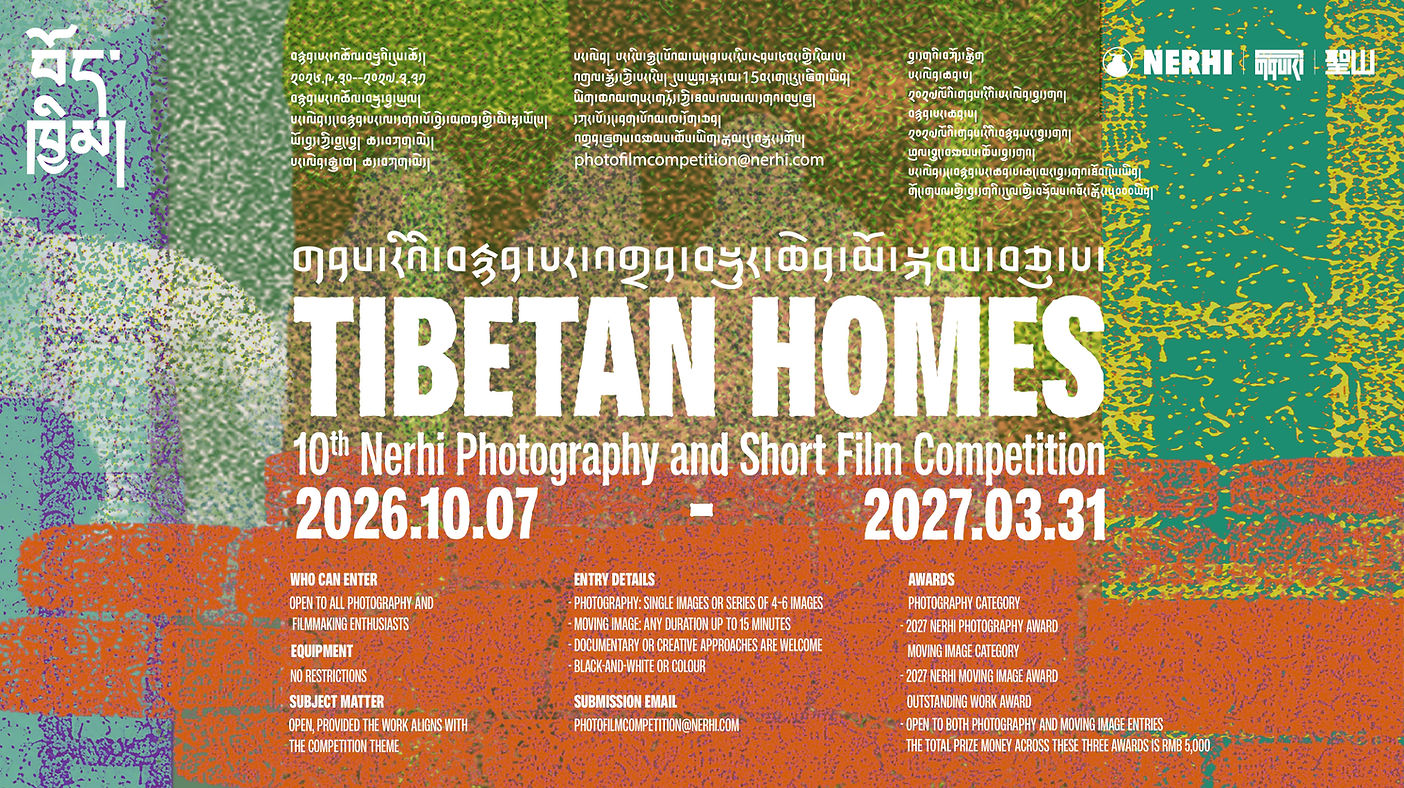
10th Nerhi Photography and Short Film Competition
Tibetan Homes
About home, and the people who make it home.
Theme Statement
We often come to know a place through a house, and a way of life through a family.
A home is more than a building. It reflects how people live, how family members relate to one another, how neighbours connect, and how daily life is shaped by the surrounding landscape, climate, and changing times.
Starting with the intimate details of individual homes, we hope to explore the broader realities of life and society — from living spaces to everyday experiences, and ultimately, to the people and relationships at the heart of a home.
To look at someone's home is to look at the life they lead.
To observe how a family lives together is to see how people become family to one another.
For this year's competition, we invite you to bring your camera home. Document the diverse homes, everyday lives, and human relationships across Tibet. Look for the moments that unfold beneath the roof, between the inside and outside, around the table, and in the countless ways people share their lives with one another.
Competition Information
Submission Period: October 7, 2026 – March 31, 2027
Who Can Enter: Open to all photography and filmmaking enthusiasts
Equipment: No restrictions
Subject Matter: Open, provided the work aligns with the competition theme
Awards
Photography Category
-
2027 Nerhi Photography Award
Moving Image Category
-
2027 Nerhi Moving Image Award
Outstanding Work Award
-
Open to both photography and moving image entries
The total prize money across these three awards is RMB 5,000. The number of awards and the allocation of prize money will be determined by the jury based on the quality and volume of submissions.
Awards will be granted according to the overall quality of the entries and the jury's evaluation criteria. The organisers reserve the right to leave any award unassigned if no entry meets the required standard. The judging process will follow principles of fairness, impartiality, and professional assessment.
All winning and outstanding works will be exhibited. Details of the exhibition venue and format will be announced through NERHI's official platforms.
How to Enter
Please provide complete information about your work, including its title, creative background, shooting location, and relevant details about the people featured, including their relationships where applicable. This information will be an important reference for the jury.
Incomplete or incorrectly submitted information may affect eligibility or the evaluation of your work.
Submission email: photofilmcompetition@nerhi.com
Please send your entry as an email attachment and include the following information in the email body:
-
Work title
-
Brief description and creative background
-
Date and location of creation or filming
-
Team information, if applicable
-
Participant's name and personal details
-
Contact information
Submission Guidelines
-
Eligible formats
Entries may consist of single photographs or photo series of 4–6 images, in colour or black and white. Both documentary and creative approaches are welcome.
Moving image entries are also accepted. There are no restrictions on style or format, provided the work aligns with the competition theme.
-
Technical requirements
For photography:
-
File format: JPG
-
Colour space: sRGB
-
Maximum dimensions: 1920 pixels wide × 1080 pixels high
-
Resolution: 300 dpi
-
Maximum file size: 4 MB per image
-
Maximum total submission size: 24 MB
For moving image:
-
File format: MPEG-4
-
Maximum duration: 15 minutes
-
No minimum duration
-
Author identification
Submitted works must not contain frames, marks, watermarks, names, signatures, or other identifying marks that reveal the author's identity.
-
Exhibition files
Submitted works will primarily be used for judging and online presentation. Selected works may subsequently be used in physical exhibitions and related activities.
Participants are therefore encouraged to retain high-resolution originals. If a work is selected, the organisers may contact the author to request a high-resolution file suitable for exhibition.
Please ensure your submission meets the theme and all technical requirements. Failure to follow the guidelines may affect eligibility or the evaluation of your entry.
Selection Process
A professional jury will conduct an initial review to exclude works that do not align with the competition's theme, principles, and objectives.
NERHI and the relevant partner association will both participate in the selection process, with each party's evaluation accounting for 50% of the decision.
Based on the initial review, 40–50 entries will be shortlisted for online public voting. The results of the public vote will account for 10% of the final evaluation.
Announcement of Finalists
The shortlist will be announced through NERHI's official platforms. Selected authors will also be notified by email.
Copyright and Usage Rights
By submitting a work to the competition, participants grant the organisers the following rights in relation to the submitted work:
-
Right of Publication: The right to decide whether to publish the work.
-
Right of Attribution: The right to identify the author by their name or pseudonym when the work is used, in accordance with the author's attribution preference.
-
Right of Reproduction: The right to reproduce the work in one or more copies through printing, copying, recording, filming, digitisation, or other means.
-
Right of Distribution: The right to make the original work or reproductions available to the public through gifting, display, or other non-commercial means. Any commercial use or sale requires the author's prior written consent. All proceeds from such commercial use or sales must support the NERHI Craft Project.
-
Right of Exhibition: The right to publicly display the original work or reproductions.
-
Right of Public Presentation: The right to publicly present visual, photographic, and audiovisual works using projectors or other technical equipment.
-
Right of Broadcasting: The right to broadcast or retransmit works to the public by wired or wireless means, including through loudspeakers or similar transmission equipment.
-
Right of Communication to the Public via Information Networks: The right to make works available to the public through wired or wireless networks, allowing members of the public to access them at a time and place of their choosing.
-
Right of Cinematographic Adaptation: The right to fix a work onto a medium through the creation of an audiovisual production.
-
Right of Translation: The right to translate the work from one language into another.